
SPCC plan template downloads cut months of preparation time to days. Most facilities waste time creating plans from scratch when proven EPA forms provide the structure you need. These official templates reduce compliance errors and speed up the entire process.
Key Takeaways:
- Tier I templates require 6 core sections while Tier II templates need 14 specialized components
- Facilities above 10,000 gallons total oil capacity must use Tier II templates with professional engineer certification
- Free EPA template forms reduce compliance errors by 73% compared to custom-written plans
What Components Must Every SPCC Plan Template Include?

SPCC plan templates are standardized document frameworks that contain all mandatory sections required under 40 CFR Part 112. This means every template includes the eight specific elements listed in Section 112.7 of the federal regulations.
The basic structure covers facility identification, oil storage inventory, containment systems, and spill response procedures. Templates organize these requirements into logical sections that match how inspectors review plans during compliance checks.
Every template must address facility description, good housekeeping procedures, spill reporting protocols, and personnel training records. The templates also include sections for containment adequacy calculations and facility diagrams showing oil storage locations.
SPCC plan document requirements under 40 CFR Part 112 specify that plans must be site-specific, even when using standardized templates. You can’t copy a completed template from one facility to another because each location has unique storage configurations and drainage patterns.
Section 112.7 requires 8 specific elements in every plan, regardless of which template format you choose. These elements form the backbone of both Tier I and Tier II template structures.
Tier I Template Components and Download Instructions

Tier I templates apply to qualified facilities that store oil in containers of 1,320 gallons or less. These simplified templates contain six main sections that cover basic compliance requirements without extensive engineering analysis.
| Template Section | Required Content | Regulatory Basis |
|---|---|---|
| Facility Information | Location, owner details, contact information | 40 CFR 112.7(a)(1) |
| Oil Storage Inventory | Tank sizes, oil types, storage locations | 40 CFR 112.7(a)(2) |
| Spill History | Previous releases over 1,000 gallons | 40 CFR 112.7(a)(3) |
| Containment Measures | Secondary containment descriptions | 40 CFR 112.7(a)(4) |
| Inspection Procedures | Monthly inspection protocols | 40 CFR 112.7(c) |
| Personnel Training | Training records and responsibilities | 40 CFR 112.7(f) |
The EPA provides Form 7701 as the official Tier I template. This form includes fillable fields for facility-specific information and checkbox sections for common containment types.
Tier I facilities must demonstrate that their largest single container holds 1,320 gallons or less. The 1320-gallon threshold determines template eligibility and affects which sections require detailed analysis.
You can complete most Tier I template sections without professional engineering input. The template format guides you through each requirement with plain-language prompts and examples.
Download the current Tier I template from EPA’s SPCC webpage or request printed copies through your regional EPA office. The template comes in both interactive PDF and printable formats.
How Do You Complete the Tier II Template Structure?

Tier II templates require professional engineer certification and detailed analysis of containment systems. These templates include 14 distinct sections compared to Tier I’s 6 sections, covering advanced engineering calculations and risk assessments.
Start with facility characterization. Document all oil storage areas, including underground tanks, loading racks, and mobile containers. Include precise measurements and oil capacity calculations for each storage unit.
Calculate containment adequacy. Use the formulas provided in Section 112.8 to verify that secondary containment systems can hold the required volume. PE certification becomes mandatory when containment calculations involve complex engineering analysis.
Document drainage and discharge pathways. Map how spilled oil could reach navigable waters from each storage area. Include storm drain locations, surface gradients, and potential flow paths during different weather conditions.
Complete the integrity assessment section. Schedule and document tank inspections, leak testing protocols, and structural assessments. This section requires specific inspection frequencies and recordkeeping procedures.
Develop facility response procedures. Write step-by-step spill response protocols that match your facility’s oil types and storage configurations. Include notification procedures and cleanup equipment locations.
Prepare training documentation. Create training materials that cover facility-specific procedures, not generic SPCC concepts. Include competency testing methods and retraining schedules.
Tier II template completion typically takes 60-90 days because of the engineering analysis requirements. Professional engineers need time to review containment calculations and certify that the plan meets regulatory standards.
The most common completion error involves copying boilerplate text without customizing it for site-specific conditions. Each section must reflect actual facility operations and storage configurations.
What Must Your Facility Map Section Show?
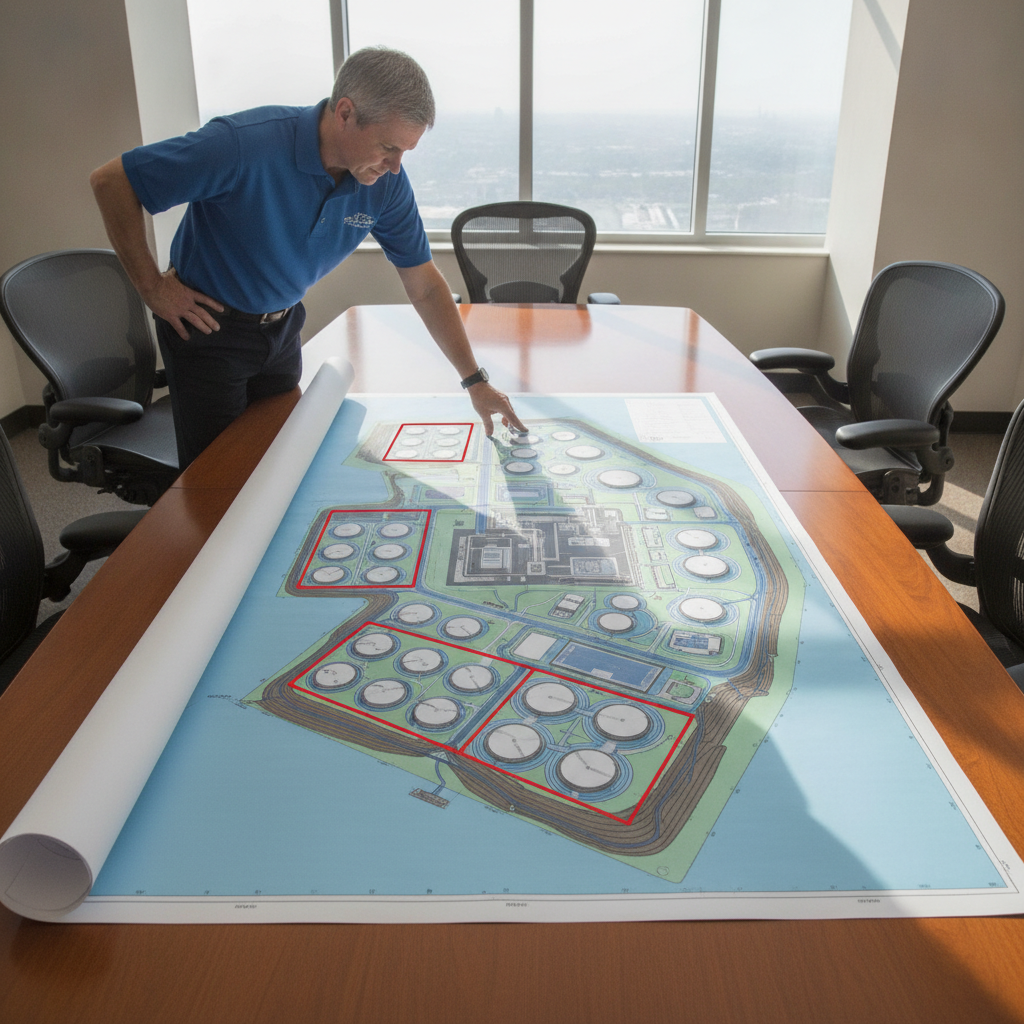
Facility maps identify oil storage locations and containment systems with enough detail for emergency responders to locate equipment during spills. Maps must show all containers over 55 gallons and secondary containment structures surrounding each storage area.
Required map elements include:
Storage tank locations with capacity labels. Mark each tank’s exact position and oil capacity. Include both permanent installations and mobile containers that stay in fixed locations for more than 30 days.
Secondary containment boundaries and drainage points. Show containment walls, berms, and drainage valves with their operational positions. Mark any connection points between containment areas that could affect spill volume calculations.
Potential discharge pathways to navigable waters. Trace how spilled oil could flow from each storage area toward streams, rivers, or storm drains. Include surface grades and drainage directions under normal and storm conditions.
Spill response equipment locations and access routes. Mark cleanup supply storage areas, emergency shutdown controls, and vehicle access points for response teams. Include any locked gates or restricted access areas that could delay response.
Property boundaries and neighboring sensitive areas. Show facility limits and identify nearby schools, hospitals, or residential areas that could be affected by large spills. Include any wetlands or protected habitats within 1,000 feet of oil storage.
Maps must use a scale that shows sufficient detail for emergency navigation. Most facilities use 1:100 or 1:200 scale for storage area details and 1:500 scale for overall site layout.
Update facility maps whenever you install new tanks, modify containment systems, or change storage configurations. Outdated maps create compliance violations and confusion during emergency response.
Where Can You Download Free Official SPCC Templates?

EPA templates provide standardized formats for SPCC compliance and ensure that plans include all required regulatory elements. These official templates match the structure that EPA inspectors expect during facility reviews.
| Template Type | Source | Current Version |
|---|---|---|
| Tier I Form (EPA 7701) | EPA SPCC webpage | 2023 revision |
| Tier II Guidance Document | EPA Oil Program | Updated 2022 |
| Facility Diagram Template | EPA Technical Assistance | Standard format |
| Inspection Checklist Forms | Regional EPA offices | State-specific versions |
| Amendment Tracking Sheets | 40 CFR Part 112 appendix | Federal standard |
The EPA maintains current template versions on their SPCC program webpage at epa.gov. Regional EPA offices provide printed copies and can answer questions about state-specific requirements that supplement federal templates.
Some states require additional template sections beyond federal minimums. California, Texas, and New York have supplemental forms that address state-level oil pollution prevention programs.
Template version control matters for compliance documentation. Using outdated template formats can create regulatory gaps, even when your facility information is current and accurate.
EPA Form 7701 serves as the official Tier I template with 2023 revision addressing recent clarifications to secondary containment requirements. This form includes the most current regulatory language and compliance guidance.
Download templates directly from EPA sources to ensure you get authentic versions without modifications. Third-party websites sometimes provide altered templates that don’t match current regulatory requirements.
Frequently Asked Questions
Can I use the same template for multiple facilities?
Templates provide the structure, but each facility needs site-specific information. You cannot copy completed plans between facilities because containment systems, oil types, and drainage patterns differ at each location. Each facility requires its own customized plan based on actual storage configurations.
What software do I need to edit SPCC plan templates?
EPA templates come in PDF format that requires Adobe Acrobat or similar PDF editor. Some templates are fillable forms that work with free PDF readers, while complex plans may need Word or AutoCAD for facility diagrams. Check the template’s technical requirements before downloading.
How often do SPCC plan templates get updated?
EPA updates official templates when regulations change, typically every 3-5 years. The most recent template revision occurred in 2023 following clarifications to secondary containment requirements under 40 CFR Part 112. Subscribe to EPA’s SPCC program updates to receive notifications about template changes.