Aboveground storage tank regulations operate on a federal baseline that most states layer with their own registration, inspection, and reporting requirements that can triple your compliance burden.
Key Takeaways:
- Federal 40 CFR Part 112 establishes baseline AST requirements for facilities storing 1,320+ gallons of oil
- 26 states maintain additional AST programs requiring separate registration, fees, and inspections beyond federal rules
- Pennsylvania Chapter 245 and New York 6 NYCRR Part 613 represent the most comprehensive state AST oversight programs
What Federal Regulations Apply to Aboveground Storage Tanks?
40 CFR Part 112 is the federal regulation governing aboveground storage tanks containing oil. This means any facility with an aggregate oil storage capacity of 1,320 gallons or more falls under EPA’s Spill Prevention, Control, and Countermeasure program.
The regulation establishes the federal AST regulatory framework under Clean Water Act authority. EPA defines “oil” broadly to include petroleum products, vegetable oils, animal fats, and synthetic equivalents. Your diesel generator, hydraulic fluid tanks, and waste oil containers all count toward that 1,320-gallon threshold.
What qualifies as a regulated aboveground storage tank? Any container sitting on or above the ground surface, including tanks on elevated platforms, skid-mounted units, and portable storage systems. Underground tanks follow different rules under 40 CFR Part 280.
Federal rules require an SPCC plan, secondary containment for certain tanks, regular inspections, and spill response procedures. The regulation covers oil discharge prevention but stops there. It doesn’t address tank construction standards, installation permits, or registration fees.
That’s where states step in. According to 40 CFR 112.1, states can impose additional requirements that exceed federal standards. Most do. The federal program gives you the baseline; state programs add the paperwork, fees, and frequent inspections that consume most of your compliance time.
EPA enforces federal violations through its regional offices. Maximum penalties reach $59,973 per day per violation under current Clean Water Act guidelines. But federal enforcement typically focuses on major spills or facilities with patterns of non-compliance.
Which States Have AST Programs Beyond Federal Requirements?
Twenty-six states operate AST programs that add requirements beyond federal 40 CFR Part 112 rules. State AST programs add requirements through registration systems, inspection mandates, and reporting deadlines that don’t exist at the federal level.
| State | Registration Threshold | Annual Fee | Key Requirements |
|---|---|---|---|
| Pennsylvania | 110 gallons | $500 | Monthly inspections, corrosion protection |
| New York | 1,100 gallons | $300-$1,000 | DEC registration, PBS coordination |
| California | Varies by county | $200-$800 | Business Plan, CUPA oversight |
| Texas | 250 gallons | $100-$400 | TCEQ registration, spill reporting |
| New Jersey | 2,000 gallons | $250 | DPRA permit, groundwater monitoring |
| Massachusetts | 10,000 gallons | $1,000 | DEP registration, financial responsibility |
Most state programs require tank registration before operation begins. Pennsylvania’s Chapter 245 sets the lowest threshold at 110 gallons, catching small generator tanks that federal rules miss. California delegates authority to 58 county-level agencies, creating a patchwork of local requirements.
Registration fees range from $100 in Texas to $1,000 in Massachusetts for large facilities. These fees fund state inspection programs that visit facilities more frequently than EPA regional staff. Pennsylvania inspects registered facilities every three years; EPA might not visit for a decade.
State programs focus on tank integrity and environmental protection. They require corrosion protection upgrades, groundwater monitoring, and financial responsibility demonstrations that federal rules don’t mandate. Some states like New Jersey require permits before tank installation.
The remaining 24 states rely on federal oversight through EPA regional offices. These states may have environmental agencies that respond to spills but don’t maintain ongoing AST oversight programs. Facilities in these states face only federal 40 CFR Part 112 requirements.
Consult your state environmental agency to determine if additional AST requirements apply to your facility beyond federal rules.
Pennsylvania Chapter 245: The Most Detailed State AST Program
PA Chapter 245 requires comprehensive AST oversight that starts at 110 gallons and applies to virtually every facility with fuel storage. Pennsylvania’s program represents the most detailed state AST regulatory framework in the country.
Pennsylvania Chapter 245 requirements include:
- Registration of all ASTs containing 110+ gallons of regulated substances. This catches generator fuel tanks, heating oil systems, and hydraulic fluid storage that federal rules miss.
- $500 annual registration fee structure per facility regardless of tank count. Multi-tank sites pay once; single-tank operations pay the same amount.
- Monthly inspection requirements documented on state-prescribed forms. Inspections cover tank condition, containment integrity, and leak detection systems with specific reporting protocols.
- Corrosion protection mandates for steel tanks installed after 1986. Existing tanks must retrofit protection systems or face removal deadlines.
- Annual testing protocols for leak detection systems and containment structures. Testing must be performed by certified technicians with results submitted to the state.
Pennsylvania enforces violations through civil penalties up to $25,000 per day plus tank removal orders. The state maintains an active inspection program with field staff visiting registered facilities every three years. Unregistered tanks discovered during inspections trigger automatic violation notices.
The program covers petroleum products, heating oils, hydraulic fluids, and waste oils. Exemptions apply to residential heating oil tanks under 1,100 gallons and farm fuel tanks used exclusively for on-farm equipment.
Pennsylvania coordinates with federal EPA enforcement but maintains separate penalty authority. A single compliance failure can result in both state Chapter 245 violations and federal 40 CFR Part 112 citations with separate penalty structures.
How Do New York AST Rules Stack With Federal Requirements?
NY 6 NYCRR Part 613 overlays federal AST requirements with a state registration system that kicks in at 1,100 gallons, 220 gallons below the federal threshold. New York’s approach creates dual jurisdiction issues that most facilities handle poorly.
| Feature | NY 6 NYCRR Part 613 |
|---|---|
| Registration Threshold | 1,100 gallons aggregate capacity |
| Annual Registration Fee | $300-$1,000 based on tank volume |
| Inspection Frequency | Every 5 years by DEC-certified inspector |
| Spill Reporting | Immediate notification plus 30-day written report |
| Financial Responsibility | $1 million coverage required for facilities over 10,000 gallons |
| Permit Requirements | Installation permit required before tank placement |
New York’s 6 NYCRR Part 613 coordinates with the Petroleum Bulk Storage program but covers different facility types. PBS focuses on commercial fuel distribution; AST rules catch manufacturing, fleet, and institutional facilities with generator fuel and process oils.
DEC requires installation permits before tank placement at facilities subject to AST registration. The permit process includes site plan review, environmental impact assessment, and public notice requirements that can extend approval timelines to 6 months.
Enforcement coordination between DEC and EPA creates confusion during violation events. New York issues state penalties under Environmental Conservation Law; EPA issues federal penalties under Clean Water Act authority. Both agencies can pursue separate enforcement actions for the same incident.
The state maintains certified inspector requirements that exceed federal standards. DEC-certified inspectors must complete annual training and carry state-issued credentials. Federal rules allow facility personnel to perform most inspections without certification requirements.
New York’s spill reporting thresholds start at any release that leaves the immediate tank area, regardless of volume. Federal rules require reporting only for releases that reach navigable waters or threaten public health.
What Secondary Containment Requirements Apply to ASTs?
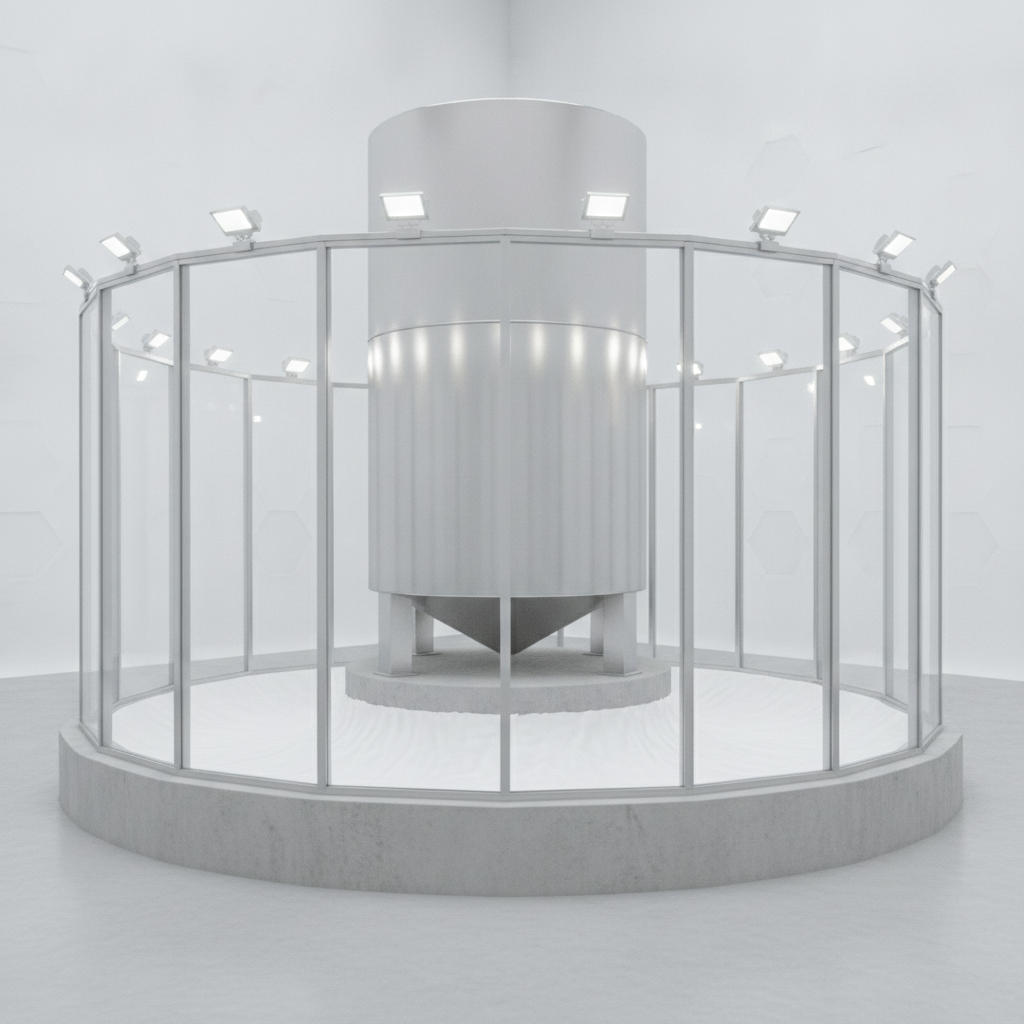
Secondary containment prevents AST spills from reaching soil, groundwater, or surface water. Federal 40 CFR Part 112 establishes baseline containment requirements that states often expand with additional design standards and inspection protocols.
Federal secondary containment requirements follow these steps:
- Calculate required containment volume using the 110% rule. Containment must hold 110% of the largest tank capacity plus 10% of all other tanks within the same containment area.
- Install containment systems that prevent discharge to navigable waters. This includes bermed areas, vaulted systems, or double-wall tanks with leak detection.
- Ensure containment surfaces are impermeable and compatible with stored materials. Concrete, steel, and synthetic liner systems must resist chemical attack from contained substances.
- Install drainage controls that prevent rainwater accumulation. Manual drain valves or pumping systems must be normally closed and attended during drainage operations.
- Inspect containment integrity monthly and document findings. Look for cracks, corrosion, drain valve position, and accumulated liquids with written records retained for three years.
States add containment requirements that exceed federal standards. Pennsylvania requires containment for all tanks over 250 gallons regardless of location. New York mandates double-wall construction for new installations near sensitive water supplies.
Containment sizing calculations become complex with multiple tanks. The largest tank determines base capacity; additional tanks contribute 10% each. A facility with 5,000-gallon, 3,000-gallon, and 2,000-gallon tanks needs containment for 6,500 gallons minimum (5,000 × 1.10 + 3,000 × 0.10 + 2,000 × 0.10).
Exemptions apply to production facilities where containment would interfere with operations, but alternative measures like rapid response equipment must be available. Mobile tanks and temporary installations under 180 days typically don’t require permanent containment systems.
California AST Rules: Beyond Federal and Into Local Authority
CA Health and Safety Code delegates AST oversight to local agencies through a unique model that creates 58 different regulatory approaches across county lines. California’s Certified Unified Program Agency system pushes AST regulation below state level into local environmental health departments.
California AST rules operate through county CUPAs that set registration thresholds, inspection frequencies, and fee structures independently. Los Angeles County requires registration at 1,320 gallons matching federal thresholds; Santa Clara County starts at 660 gallons. Alameda County charges $200 annual fees; Orange County charges $800 for equivalent facilities.
Business Plan requirements apply to most AST facilities regardless of size. The plan details stored materials, quantities, locations, emergency contacts, and spill response procedures. CUPAs use Business Plans to prioritize inspection schedules and assess violation penalties.
Local CUPA authority extends to tank installation permits, construction standards, and removal procedures. Some counties require soil testing before tank installation; others mandate groundwater monitoring for facilities near water supplies. These requirements don’t exist in federal rules or most state programs.
Enforcement varies dramatically by county. San Francisco CUPA maintains aggressive inspection schedules with annual visits to high-risk facilities. Rural counties might inspect registered facilities every five years due to staffing constraints.
California coordinates CUPA programs through CalEPA oversight, but local agencies maintain independent penalty authority. Violation notices come from county environmental health departments, not state or federal agencies. Appeal processes follow county administrative procedures.
The delegation model creates compliance challenges for multi-county operators. A company with AST facilities in three California counties faces three different registration systems, fee structures, and inspection protocols. Federal 40 CFR Part 112 requirements apply uniformly, but local overlay requirements change at county boundaries.
Frequently Asked Questions
Do all states require AST registration beyond federal requirements?
No, only 26 states maintain active AST registration programs that go beyond federal 40 CFR Part 112 requirements. The remaining states rely on federal oversight through EPA regional offices for AST compliance. States without their own programs may still respond to spills and enforce environmental laws, but they don’t require ongoing registration or routine inspections.
Can state AST violations result in separate penalties from federal violations?
Yes, state AST programs operate under separate legal authority from federal rules. A single compliance failure can trigger both state and federal enforcement actions with separate penalty structures. Pennsylvania can issue Chapter 245 violations while EPA pursues 40 CFR Part 112 penalties for the same incident, resulting in dual financial exposure.
What happens if federal and state AST requirements conflict?
State AST requirements cannot be less stringent than federal 40 CFR Part 112 rules. When conflicts occur, the more restrictive requirement applies, which is typically the state rule. For example, if federal rules require monthly inspections but state rules require weekly inspections, you must inspect weekly to satisfy both programs.
Do mobile or temporary ASTs need to comply with state registration programs?
Most state AST programs include mobile storage units if they remain at a facility location for more than 180 days. Pennsylvania Chapter 245 covers portable tanks after 90 days at the same location. Consult your state environmental agency for specific temporary storage exemptions, as thresholds vary significantly between states with active AST programs.